Abstract
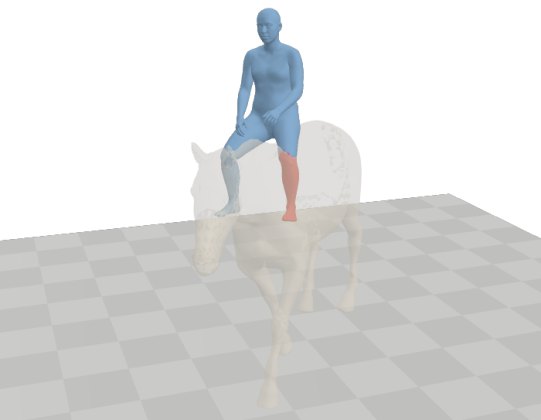
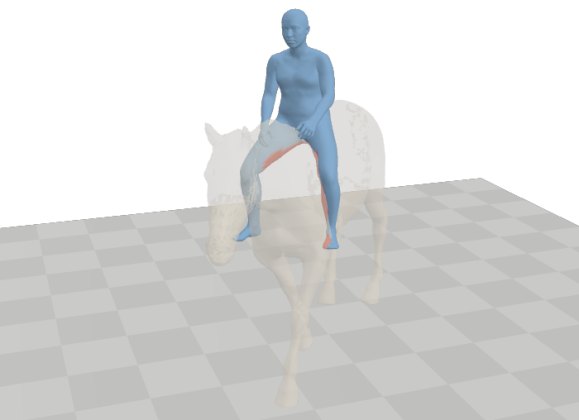
We address the reconstruction of a horse and its rider from a single video. When a human estimator and a horse estimator are applied independently, both meshes can fit their silhouettes well while the rider hovers beside or passes through the horse, slides along its back and jitters relative to it from frame to frame. These errors lie along the camera axis and are not visible in the input view. We present Ride on Anything (RoA), a general, training-free methodology for reconstructing a person riding an animal, which couples a frozen human estimator and a frozen estimator of the mount at test time. We instantiate it for horseback riding with SAM 3D Body and 4DEquine. RoA aligns the outputs of both estimators on a common frame index, projects both subjects through a single pixel-isotropic camera initialized from the horse estimator, and jointly optimizes bounded corrections under interaction terms defined in the horse's body frame, including a collision term based on generalized winding numbers that remains valid on the non-watertight horse mesh. The result is then lifted to a levelled world frame. On our riding clips, RoA keeps the rider's pelvis about 1 cm from the horse's back, reduces the drift of the seat relative to the horse and the penetration of the rider into the horse, and makes the motion markedly smoother; per-clip numbers are listed below each result. A quantitative evaluation of 3D accuracy awaits calibrated recordings of ridden animals.
Interactive results
Drag to orbit, scroll to zoom, right-drag to pan. Far side shows the side the camera never saw; Compare shows the baseline and RoA side by side with a shared camera.
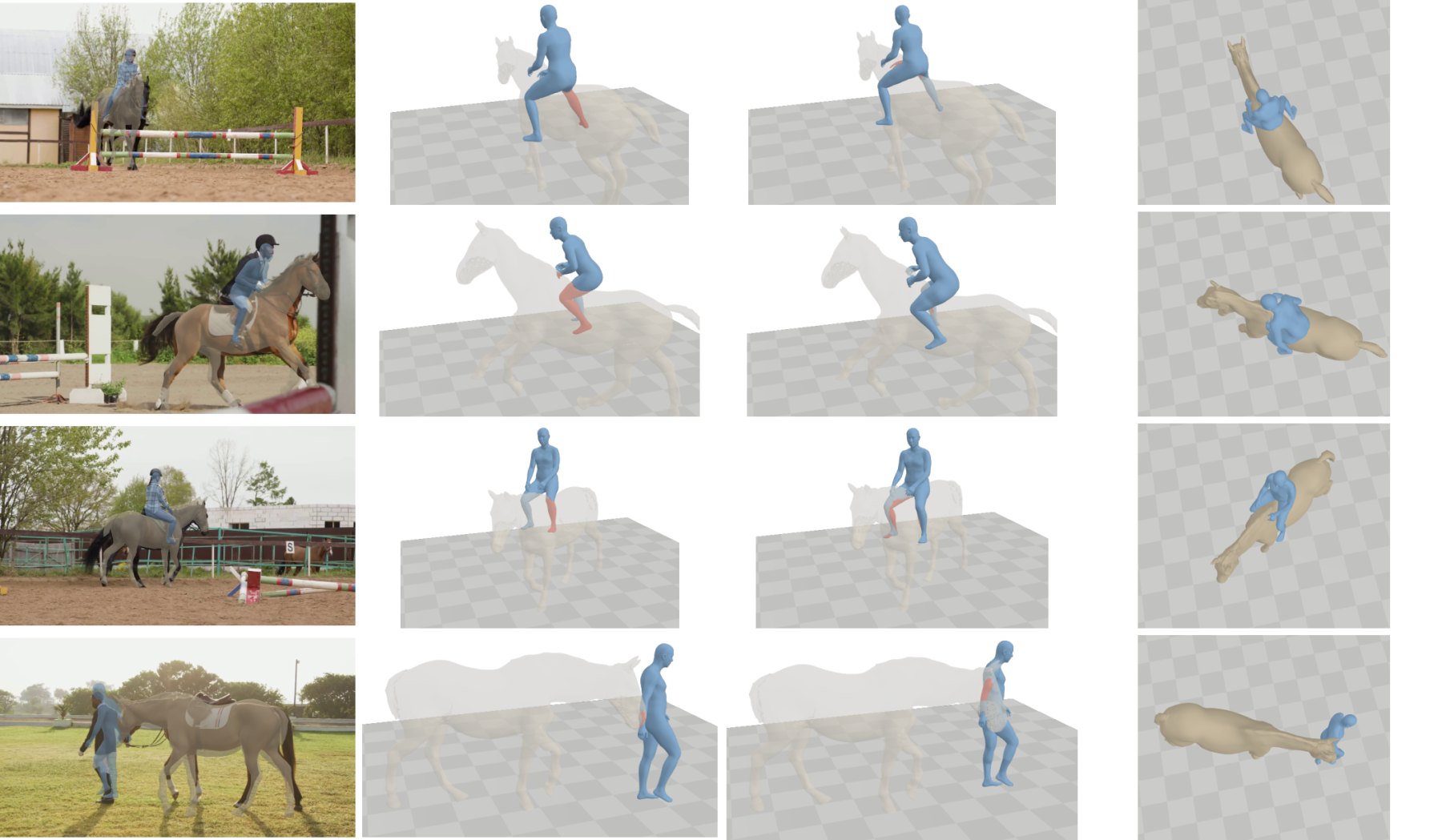
About the Lead clip. RoA is a method for riding. In Lead the horse is led by a person walking beside it and nobody is mounted, so the clip is outside the scope of the methodology. RoA still applies its riding terms and pulls the person towards the horse's back, so poor results on this clip are expected. We include it only as a quick look at this failure case; detecting whether a person is actually riding, and switching the riding terms off otherwise, is left to future work.
Result videos
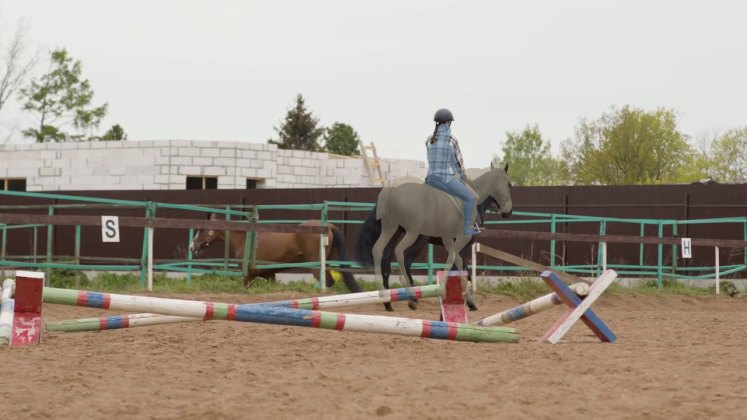
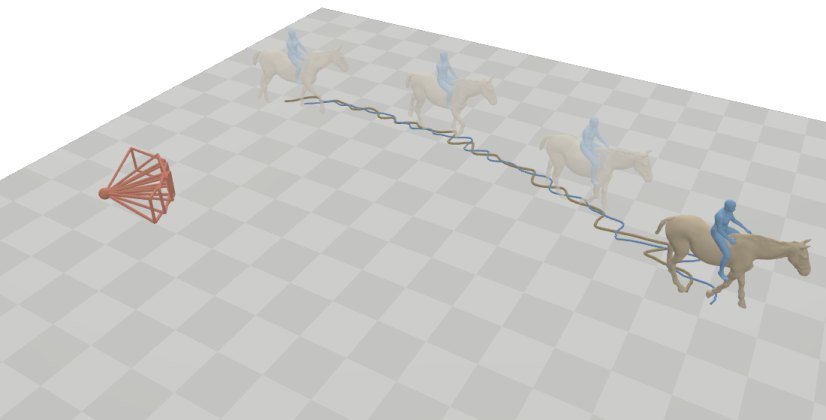
(a) input with RoA overlaid, (b) the baseline (raw estimator outputs) seen from the side opposite the camera, (c) RoA from the same side, (d) RoA in the world frame with the estimated camera (red). Red on the rider marks surface inside the horse.
Method
- Frozen estimators. 4DEquine predicts the VAREN horse mesh and a crop camera; SAM 3D Body predicts the MHR rider mesh. YOLO11 provides instance masks.
- Temporal alignment. Both outputs are indexed on source frames; only the longest run in which both subjects are present is kept, so no sequence is resampled in time.
- One pixel-isotropic camera for both subjects, initialized from the horse estimator's crop camera.
- Joint optimization in the horse's body frame of bounded corrections: image terms with a differentiable z-buffer, saddle coupling, straddle clearance and a generalized-winding-number collision term that works on the non-watertight horse mesh.
- World lifting with the camera rotation from background homographies and the field of view from MoGe-2.
Only the mesh model, its estimator and a few canonical regions on the mount's rest pose are specific to horses; the alignment, camera, objective and world lifting apply to any ridden animal with a fixed-topology mesh model.

Limitations
No 3D ground truth exists for these clips: the metrics measure plausibility (penetration, drift, smoothness) and agreement with automatic masks, not accuracy. RoA deforms the estimators' meshes within small bounds instead of re-decoding body-model parameters; depth along the camera axis is only weakly constrained when the horse faces the camera; the world frame assumes a camera that only rotates. The Lead clip, a horse led by a person on foot, is not riding and therefore outside the scope of the methodology; its poor result is expected, and handling unmounted people is left to future work.
BibTeX
@article{weng2026rideonanything,
  title   = {Ride on Anything: Contact-Coupled Monocular 4D Reconstruction of a Rider and Horse in Camera and World Frames},
  author  = {Weng, Zehang and Li, Ci},
  journal = {arXiv preprint},
  year    = {2026}
}
Acknowledgements
RoA builds on SAM 3D Body, 4DEquine and the VAREN horse model, MoGe-2 and YOLO11; each keeps its own licence. The input clips are publicly available stock videos.